Welcome
Welcome to StockAstrologer.com!

Although a scientist by profession, Dr. Raj Chadha has been interested in Vedic astrology since childhood. He has practiced astrology and advised friends and family for more than 45 years. He is also the author of A Practical Guide to Hindu Astrology.
Dr. Chadha has conducted extensive research into the relationship between planetary transits and stock price movements. Guided by a research-oriented approach, he does not rely solely on conventional astrological theories. Instead, he develops and tests his own ideas, carefully evaluating them against historical data before presenting them on this website.Some investors rely on fundamental analysis to evaluate companies and select stocks. Others use technical analysis to understand the behavior of market participants and price trends. While both methods have their strengths, neither can fully account for future uncertainties. Astrological analysis can provide valuable insights into a stock’s future performance and is best used alongside fundamental and technical analysis.
To prepare a stock’s astrological chart, I use the stock’s first trading day as its birth date and the exchange opening time as its birth time. The company’s headquarters is used as the place of birth, with the birth time adjusted accordingly.
A significant portion of a stock’s price movement is influenced by the direction of the overall market. I once used the birth chart of the United States to forecast market trends. Over time, however, I found that the opening chart of the New York Stock Exchange produces more reliable results. The chart is cast for May 17, 1792, at 10:30 AM, New York, NY.
Because astrology remains a subject of skepticism for many Americans, all information on this website is provided free of charge. My sincere goal is to demonstrate that astrology can be a valuable tool in the hands of an experienced practitioner. Nature has provided us with the language of planetary motion; we should seek to understand and utilize it rather than ignore it.
with Vedic Astrology
and financial markets — now brought together
in two comprehensive volumes.

Yearly Forecast for S&P 500

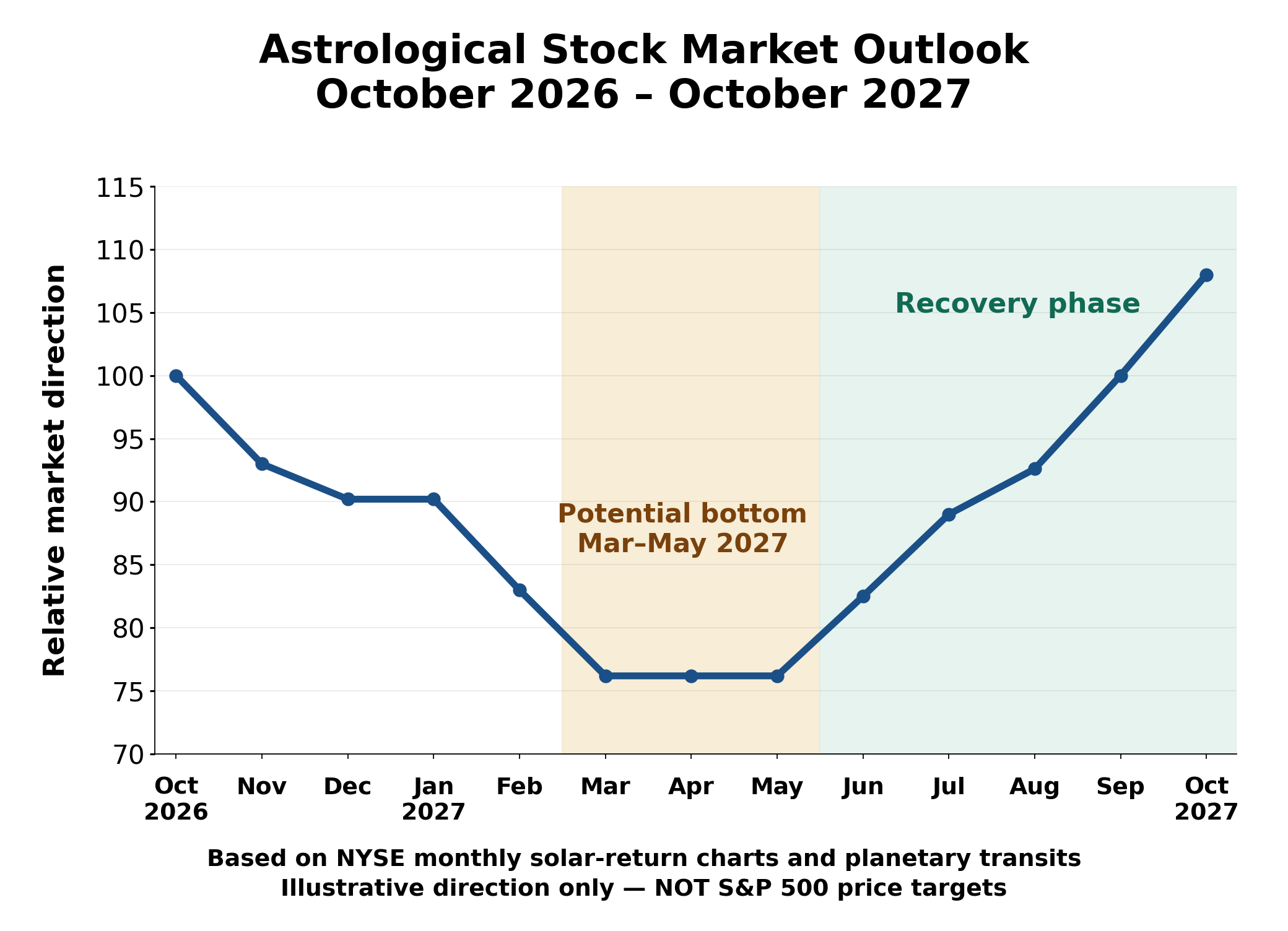
My analysis of the New York Stock Exchange (NYSE) monthly solar-return charts suggests a difficult period for the stock market from late 2026 through spring 2027, followed by a strong recovery in the second half of the year. The accompanying chart illustrates the expected market direction rather than actual S&P 500 index levels.
Planetary transits reinforce this cautious outlook. Mars is currently approaching Ketu, a conjunction associated with disruption. Mars turns retrograde in February 2027 and forms a square aspect with Uranus, suggesting the possibility of sudden market reversals and heightened volatility. Mercury also enters its sign of debilitation, Pisces, during February, adding another potentially unfavorable influence.
In April 2027, retrograde Mars approaches within one degree of Ketu before turning direct. This configuration may coincide with an important market turning point. Interestingly, the NYSE monthly solar-return charts independently suggest that the market could establish a bottom around March–May 2027.
Taken together, these astrological indications suggest continued market weakness during the first several months of 2027, followed by improving conditions beginning around May or June. The second half of 2027 appears considerably more favorable, with the possibility of a sustained advance through December.
This forecast therefore differs from the usual seasonal pattern. It is based primarily on the combination of NYSE solar-return charts and planetary transits, as described in Volume II of my books.
As always, astrology indicates probable market direction rather than precise index levels, and actual market movements may differ from these projections.
The picture above depicts how the S&P 500 could behave between November 2026 and October 2027, though I am not sure how much of it will actually materialize. Still, it is worth keeping in mind.
Monthly Forecast for S&P 500


The U.S. stock market is likely to be volatile during the next solar month (Oct 20 2026, to Nov 18, 2026), with a downward bias. The ascendant is Capricorn, and its ruler, Saturn, is fallen in the fourth house, which in turn aspects the ascendant. The ascendant is therefore weak. This setup is clearly negative. In addition to Saturn, the Sun is also fallen in Libra, and it occupies the tenth house. Moon in Aquarius, and Venus in Scorpio also cannot be considered strong. Two benefic planets Jupiter and Moon aspect each other. This is a positive facotr. The rulers of the third house, Jupiter, and of eleventh house, Mars, occupy the eighth house. This factor is also, therefore, not helpful. Taking all factors into account, the outlook appears negative. Therefore, the stock market may present challenges during this month.
Monthly Gold Forecast
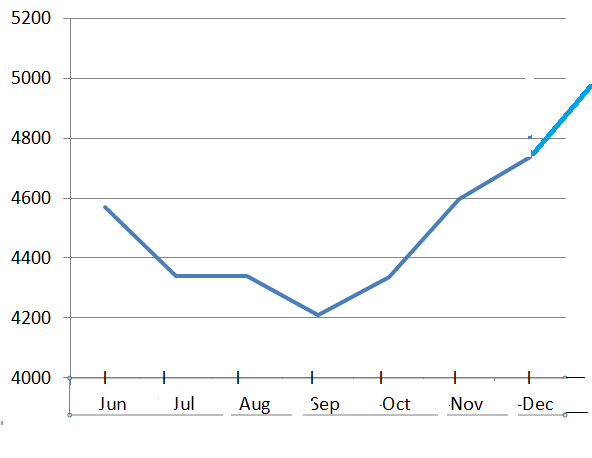
In September 2026, the price of gold moved higher from $4300 to $4200 an ounce. I was expecting it to remain flat or go slightly higher.
The gold price may move slightly higher in October 2026. Jupiter is moderately strong and Mars and Saturn are weak in the monthly solar return chart, based on the Gold-London FIX (2/19/1968). This is positive. A strong planet indicates abundance, which causes the price to go lower. On the other hand, a weak planet indicates an shortage of the commodity, leading to higher prices. I, therefore, think the price of gold may go slightly higher in October 2026.
Monthly Bitcoin Forecast
November 2026: Slightly higher
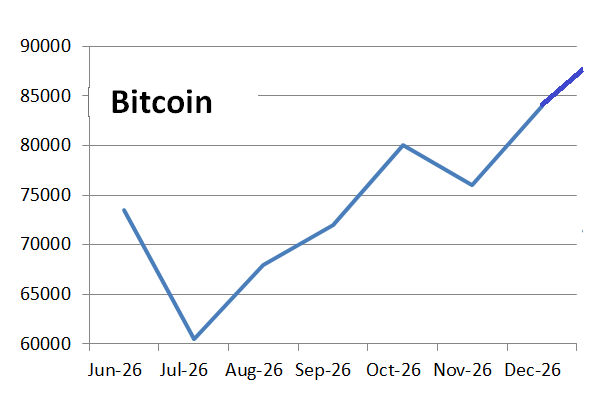
The price of Bitcoin may go slightly higher in November 2026. The monthly solar chart starts on November 05, 2026, at 22:20. The planet Rahu occupies the seventh house in the sign Aquarius. Rahu is strong in this house and sign. However, it forms a opposite aspect with Jupiter in Leo. Jupiter is a benefic planet and is an friend of Rahu. Taken together, it is possible that Bitcoin's price may rise slightly in November 2026.
Follow on Twitter / X
